Popular Tauromaquia: A Spectacle on the Rise, A Growing Market
Popular Tauromaquia
This is not a fight with capote (bullfighter’s cape) and muleta (small red cloth), but in many ways, it can be considered its precursor. Popular Tauromaquia is deeply connected to the people, and even today, it is the townsfolk who demand and sustain it.
In the previous article, we explored the various types of Bous al Carrer (bull in the street). In this piece, we will distinguish between the different types of popular tauromaquia that take place in a bullring. This is a growing phenomenon, attracting an increasing number of enthusiasts and creating a rising demand in a market that often complements – and sometimes even rescues – traditional bullfighting fairs. These are the main types of events:
Recortes Competition
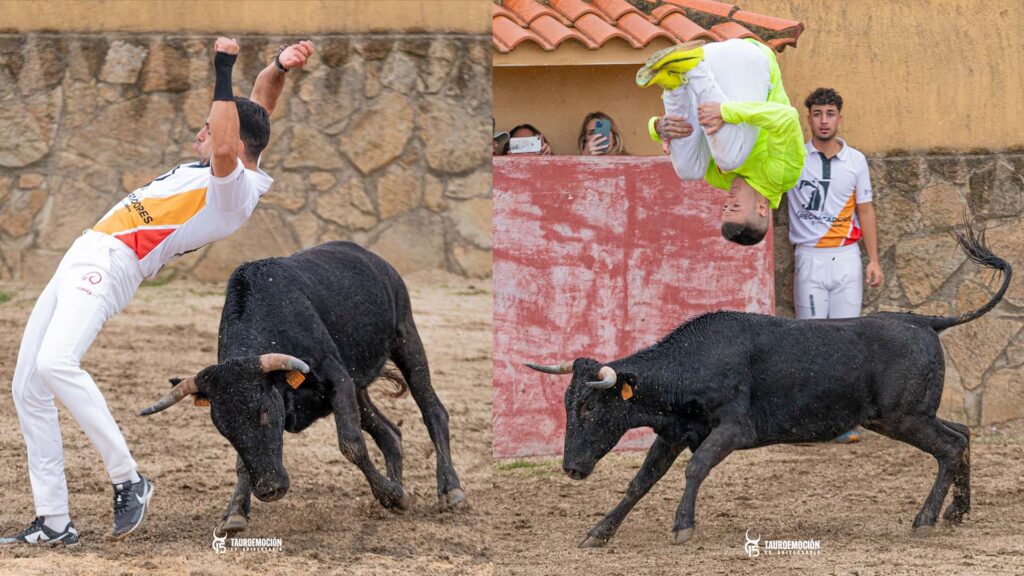
This is the quintessential popular event. It consists of dodging the bull’s charge with clean movements, relying solely on body agility. Participants, called recortadores (bull dodgers), compete in teams of three or four. Each team faces a bull for a set time, during which every recortador performs a predetermined number of recortes (dodges).
The best performer from each group, as judged by an appointed jury, advances to the final round to face the most imposing bull of the event. The winner is the recortador who executes the best recorte in the final. In Castilla y León, this type of event is commonly called a “Cortes Competition,” and the recorte is referred to as a “corte.”
Jump and Quiebro Competitions
The format is similar to a recortes competition, but participants are allowed to perform jumps or quiebros (turns). In a recorte, the bullfighter approaches the bull, dodging its charge with a twist of the waist as the bull passes behind him. In a quiebro, the bullfighter stays still and lets the bull come to him, dodging it at the last moment.
Jumps involve leaping over the bull, and there are various types, such as the “angel jump,” “feet-together jump,” “corkscrew jump,” and “somersault jump.”
Exhibitions
Similar to the above events, exhibitions showcase recortes, jumps, and quiebros, but they are not competitive. Recortadores or jumpers display their skills without vying for victory, and no winners are declared.
Anilla Competitions
In this event, participants work in pairs. The goal is to place as many rings as possible on the bull’s or cow’s horns within a set time. The winning pair is the one that attaches the most rings.
This type of event is particularly popular in the Ebro River region, encompassing La Rioja, Navarra, Aragón, and parts of the Valencia and Madrid communities. The livestock involved usually comes from breeders in these regions.
Landesa or Vascolandesa Corrida and Camarguesa Corrida
These are traditional events from southwest and southeast France, respectively, held almost exclusively in these areas. Each has its own rules and unique characteristics, featuring local breeds of cattle.
Even the arenas differ slightly from conventional bullrings. Many are adapted later to host traditional Spanish bullfighting events. In the Camarguesa corrida, the cattle are native to the region, adding to the event’s distinctiveness.
Roscaderos Competition
In this event, teams of five carry a wicker basket and aim to attract the bull’s attention while enduring its charges. The winning team is the one that achieves the most successful “entries” within a set time.
The competition takes place within two concentric circles. The team must remain inside the smaller circle, while the bull must exit the larger circle for an entry to count. This event originated as a type of trial carried out on ranches in the Ebro River region, where it remains most popular today.
Emboladores Competition
This event involves emboladores (fire bull handlers) competing to attach flaming balls to the bull’s horns as quickly and skilfully as possible. Teams are judged on speed and execution by an appointed jury.
The most prestigious emboladores competitions take place in the upper Ebro basin and the Levantine coastal regions, where this tradition is most deeply rooted.
Festejo Popular: Emboladores
These diverse forms of Popular Tauromaquia reflect a rich cultural heritage that is still thriving today, offering an exciting and accessible way for locals and tourists alike to connect with Spain’s bullfighting traditions.